 |
|||||||||||||||
|


|
Natural Spices - Turmeric and Black Peppers - May Reduce Risk of Cancer
Curcumin, a powerful component of turmeric, a popular Indian spice, and piperine, an extract found in black peppers have been demonstrated to stop the growth of stem cells that spawn breast cancer tumors, according to a study from the University of Michigan.
The research findings show a decreased number of stem cells while having no effect on normal, non-cancerous stem cells. These results are the first to suggest that dietary compounds have the potential to reduce the risk of cancer by targeting stem cells. The results of the study are published in Breast Cancer Research and Treatment. 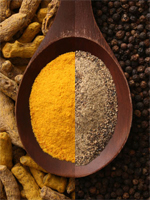 These exciting research results follow findings in November from a study published in the British Journal of Cancer. The study found that the "curry spice" curcumin, a powerful component of turmeric and a popular Indian spice, demonstrated to help kill cancer cells in patients with esophageal cancer. Researchers believe that curcumin can inhibit the growth and metastasis of tumors in certain types of cancers. Curcumin has also been used and studied in treatment of a wide variety of diseases, from cardiovascular disease, Alzheimer's disease, and type II diabetes to Crohn's disease, psoriasis and arthritis.
"Independent research studies show that in Asian countries where consumption of natural herbs and spices such as curcumin and fermented soy is integral to traditional diets, we see a much lower cancer rate in the population." - Dr. Vijaya Nair, M.D. Soy Foods May Reduce Recurrence Rates of Breast Cancer Soy foods, which contain isoflavones and antioxidant compounds, have been demonstrated to reduce the recurrence rates of breast cancer, according to a study in Journal of the American Medical Association. The study, the largest to examine soy intake's impact on breast-cancer survival, followed more than 5,000 breast-cancer survivors. 4-year mortality rates were 10.3% and 7.4%, and the 4-year recurrence rates were 11.2% and 8.0%, respectively, for women in the lowest and highest quartiles of soy protein intake. The inverse association was evident among women with either estrogen receptor-positive or -negative breast cancer and was present in both users and nonusers of tamoxifen. Among women with breast cancer, soy food consumption was significantly associated with decreased risk of death and recurrence. The study was done by researchers from the Division of Epidemiology, Department of Medicine, Vanderbilt Epidemiology Center and Vanderbilt-Ingram Cancer Center, Vanderbilt University Medical Center, Nashville, Tennessee and Shanghai Institute of Preventive Medicine, Shanghai, China "In order to reap the nutritional and anti-cancer benefits of soy, it must be fermented. The culturing of soy destroys the anti-nutrients in soy that prevent the body from absorbing essential minerals and trace elements." - Dr. Vijaya Nair, M.D.
Want to read more on this and related topics?
|
Articles
|